




Bachelor of Arts Minor in Ethnomusicology (60 ECTS)
Are you curious about musical expressions from your own culture and from around the world?
Are you interested in the social significance of music? How globalization, media, migration, gender, religion, and politics influence music-making? How people in diverse cultures learn, create, and express themselves in different styles? Are you excited about the idea of becoming involved in field work projects, making recordings, and working with musicians and communities? Would you like to develop international competencies and engage with artists and scholars from around the world? Then we welcome you to our BA minor in Ethnomusicology.
The BA in Ethnomusicology (60 ECTS) at the University of Würzburg encompasses:
GLOBAL MUSICAL KNOWLEDGE
Explore musical systems, practices, and cultures from transcultural and global perspectives.
THEORY
Engage with ethnomusicological and critical cultural theories. Understand music-making as cultural phenomenon and social process.
APPLIED ETHNOMUSICOLOGY
Bridge theory and practice. Make academic work relevant to society.
PERFORMANCE PRACTICE
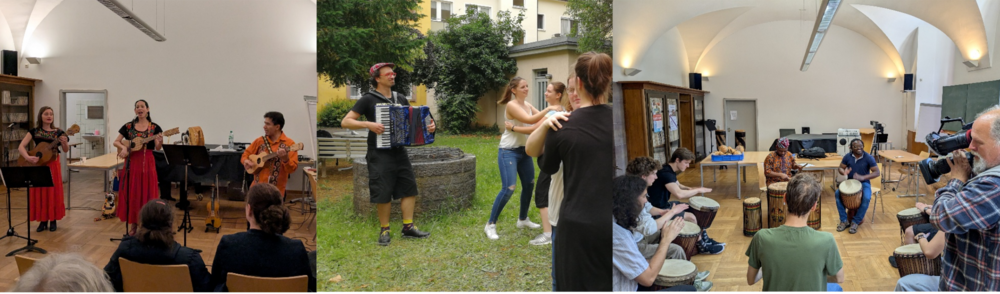
Experience music-making in diverse local and global traditions.
RESEARCH PROJECTS
Learn about field research, audiovisual recording, and applied methods. Gain experience with ethnographic and musical analysis.
INTERDISCIPLINARITY
Select courses in musicology, music education, ethnology, sociology, museum studies, media studies, diversity management, and various cultural, language, and area studies.
INTERNATIONAL ORIENTATION
Study and network with musicians and scholars from across the world.
Program Description
At the BA level, Ethnomusicology can be studied as a minor subject with 60 ECTS points. This three-year (six-semester) program integrates music studies and sociocultural studies from interdisciplinary and global perspectives. Students acquire basic practical and theoretical knowledge about diverse music-cultures and practices from around the world and their sociocultural significances. In analyzing a variety of musical idioms – from traditional to contemporary, elite to vernacular, and European to non-European to transcultural – students will gain insights into different transmission, performance, and creative practices as well as globally aware approaches to musical analysis. In exploring the relationships between music and identity, race, gender, economics, religion, migration, ecology, and other social issues, students will become critically aware of the social influences on music-making and the impacts of music-making on society. Ethnomusicological qualitative research methods will be introduced, along with interdisciplinary perspectives from across the humanities and social sciences. The integration of theory and practice is a central component of the program. In addition to academic seminars, students may have the opportunity to carry out independent and practical Applied Ethnomusicology projects and to creatively engage with diverse musical traditions in practical courses taught by expect artists from around the world. This cross-cultural and interdisciplinary foundation will allow students to approach future work in the cultural, social, public, and/or educational sectors with a breadth of artistic and cultural understanding and critical thinking abilities. The BA program also prepares students for the MA program in Ethnomusicology. View the Learning and Qualification Objectives (in German).
Program structure and course requirements
The core required courses make up 20 ECTS points and comprise the Music and Society lecture class and student project and the Musical Traditions of the World lecture class and student project. The remaining 40 ECTS credits are chosen by students from four elective categories: Ethnomusicological Theory, including academic courses on select socio-musical topics and regional musical studies; Ethnomusicological Praxis, including practical music-making courses and Applied Ethnomusicology projects; Sociocultural Studies; and Interdisciplinary and Regional Studies. For more details, see the Description of Studies (Studienfachbeschreibungen, SFB) , the Module Handbook , and the recommended Schedule of Study (Studienverlaufsplan, SVP).
Ethnomusicology course offerings
Required Classes (offered every year):
- Music and Society Lecture Class and Project
- Music Traditions of the World Lecture Class and Project
Examples of recent elective classes (continuously vary):
- Applied Ethnomusicology Projects
- Audio Recording and Editing Techniques
- Balkan urban traditional vocal and instrumental music
- Bavarian Folk Music
- Cross-Cultural Audio Analysis
- Finnish Folk Music from Ancient to Avant-Garde
- Gender and Sexuality in Traditional and Popular Musics
- Global Music History
- Latin American Music and Culture
- Musical Communities in Diaspora
- Musical Ecstacy: Gendered, Migrant, and Multi-Species Perspectives from the Arabic World
- Music Traditions of South Asian Religions
- Musics of Turkey in History and Today
- Organology
- Othering and the Reception of Minority Music
- Power, Politics, and Identity in South African Music
- The Ethnomusicology of Dance and Movement
- World Music Festivals: Transcultural Encounters
- US-American Vernacular Musics
Examples of recent practical ensemble classes (typically rotate and vary):
- African Music, Song, and Dance
- American Shaped Note Singing
- Flamenco in Rhythm, Body Percussion, and Song
- Franconian singing, dancing, and playing
- Improvisation in the Arabic Maqam system
- Irish Music and Dance Ensemble
- Klezmer music
- Kurdish and Iranian Music
- Middle Eastern Ensemble
- Oud, Arabic Lute
- South Indian Vocal Percussion
Current course offerings
See the current Ethnomusicology classes posted on the institute’s homepage under Lehrveranstaltungen am Institut für Musikforschung. See also the current course catalogue on WueStudy.
Fächerkombinationen
Degree combinations
The BA minor in Ethnomusicology may be combined, in principle, with any 120-credit program offered at the University. Recommended options are to combine Ethnomusicology with Musicology, Music Education, Digital Humanities, Diversity Management, Geography, Museum Studies, Political and Social Sciences, or language or area studies programs such as Chinese Studies, South Asian Studies, English/Americanistic, Slavic/Russian Studies, or Spanish. See a complete list of degree options here.
Study abroad
Students are encouraged to study abroad in their third, fourth, or fifth Bachelor-semester. Visit the International Office and consult with our Institute’s international exchange program liaison Dr. Martin Dippon for more details.
Language of Study
The Instruction is offered in a combination of German and English. Core required lectures are generally held in German but often assign English readings and host international English-speaking guests. Elective courses taught by international instructors may be in English. In Ethnomusicology classes, students have the choice of presenting and writing their projects in German or English, and there are many opportunities for students to improve their English skills. (Note that classes offered through partner programs, for example in Musicology or Ethnology, may have different language requirements). Proficiency in German is required and English competency at level B2 or higher is highly recommended.
Eligibility requirements
There are no field-specific entrance exams or auditions for the Ethnomusicology BA program. All students accepted to undergraduate studies at the University of Würzburg are welcome to join our BA in Ethnomusicology program. German language proficiency is required. Due to the international orientation of the field, English at level B2 or higher is strongly recommended. Basic musical experience and general knowledge of one or more musical traditions (whether classical, traditional, popular, European or non-European music) is recommended. See the Fachspezifische Bestimmungen (FSB) section 4 for admission requirements to Ethnomusicology.
Eligibility requirements for university study are based on the points listed in the Allgemeine Studien- und Prüfungsordnung für die Bachelor- und Master-Studiengänge (ASPO), section 5(1), including a general or relevant subject-related higher education entrance qualification.
To Apply
Applicants with a high school diploma from a German school can apply online here.
Applicants with an international high school diploma can apply through the International Office.
Students may begin their studies in either winter semester or summer semester.
Deadlines
16th March to start in summer semester
24th September to start in winter semester
Questions?
Contact Dr. Clara Wenz (during Dr. Wenz’s parental leave, contact Fabio Dick). International students may also contact the International Office.
Documents
- Study Regulations (Fachspezifische Bestimmungen, FSB)
- Learning Objectives (Qualifikationsziele)
- Module Handbook (MHB): MHB1-en-B1-f96-N-2021, MHB2-en-B1-f96-N-2021
- Description of Study with Overview of Modules (Studienfachbeschreibungen, SFB): SFB-en-B1-f96-N-2021
- Schedule of Study (Studienverlaufsplan, SVP)
Examination and Audit Committee (Prüfungsausschuss) for the BA in Ethnomusicology
Prof. Juniper Hill (Chair), Dr. Clara Wenz, Dr. Oliver Wiener