


Master of Arts in Ethnomusicology (120 ECTS and 45 ECTS)
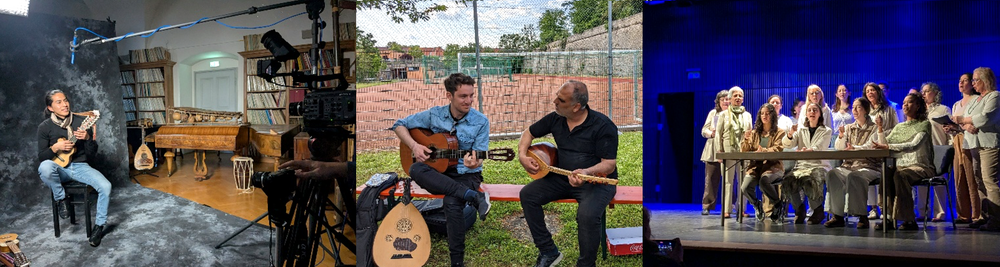
Would you like to learn about and research musical expressions from your own culture and from around the world?
Are you interested in the social significance of music? How globalization, media, migration, gender, politics, or religion influence music-making? How people in diverse cultures learn, create, and express themselves in different styles? Are you excited about the idea of conducting your own field work project, making recordings, and working with musicians and communities? Would you like to enhance your international competencies and engage with artists and scholars from around the world? Then we welcome you to our MA programs in Ethnomusicology.
The MA in Ethnomusicology programs encompass:
THEORY
Ethnomusicological and critical cultural theory
RESEARCH METHODS
Fieldwork and audiovisual recording
APPLIED ETHNOMUSICOLOGY
Bridging theory and practice, connecting academia to communities
PERFORMANCE PRACTICE
Music-making in diverse traditions
STUDENTS‘ OWN RESEARCH PROJECTS
Field research and/or applied methods at home or abroad
INTERDISCIPLINARITY
Select courses in musicology, music education, ethnology, sociology, museum studies, media studies, diversity management, and various cultural, language, and area studies.
INTERNATIONAL ORIENTATION
Study and network with musicians and scholars from across the world
Program Description
The MA program is two years (four semesters) full-time, including three semesters of coursework and one semester of supervised independent research (part time studies are also possible). Students develop a strong foundation in ethnomusicological and cultural theories and in ethnographic and qualitative research methods, with an emphasis on enabling and guiding students in conducting their own original fieldwork and contributing to international theoretical discussions. Students have the opportunity to explore and deepen their knowledge of multiple world music traditions and examine a variety of socio-musical issues and questions. The final independent research project is on a music culture and socio-musical theme of the student’s choosing and may draw on ethnographic research, music analysis, practice-based research, archival/historical research, and/or mixed methods. We emphasize Applied Ethnomusicology and encourage community engagement. This program prepares students to pursue advanced academic work in Ethnomusicology as well as more applied work in the public, cultural, and education sectors.
Single- and Double-Degree Options
Ethnomusicology can be studied at the Master’s level as single-subject degree or as a double-subject degree. The single-subject degree comprises 90 ECTS credits of coursework and a Master’s thesis based on original research worth 30 credits. If pursuing a double-degree, students complete 45 credits of coursework in Ethnomusicology and 45 credits of coursework from another discipline of their choice; the Master’s thesis (30 credits) can be completed in either Ethnomusicology or the other discipline.
Double-degree combinations
The MA in Ethnomusicology as double-degree may be combined, in principle, with any other 45/75-credit master’s program offered at the University. The most common combinations are Ethnomusicology with European Ethnology and Empirical Cultural Studies, Music Education, or Musicology. Other options include: Archaeology, Art History, Computational Humanities, Egyptology, English-Speaking Cultures, French, German, Italian, History, Linguistics, Museum Studies, South Asian Studies, Philosophy, Political and Social Sciences, Russian Language and Culture, and Spanish. See the list of double-degree options here. (Note that other programs may have different entrance requirements.)
Program structure and course requirements
All MA students are required to take the core classes Theorizing Music & Culture and Ethnographic & Qualitative Research Methods. Students in the single-subject program are additionally required to take the Applied Ethnomusicology Seminar and a course in audio and video editing techniques. The elective courses comprise a variety of rotating options on contemporary themes in Ethnomusicology, music cultures from around the world, interdisciplinary opportunities, and practical music-making courses. For more details, see the Description of Studies (Studienfachbeschreibungen, SFB), the Module Handbook, and the recommended Schedule of Study (Studienverlaufsplan, SVP) (links to additional document versions can be found below).
Ethnomusicology course offerings
Core Classes (offered every year):
- Theorizing Music and Culture
- Ethnographic and Qualitative Research Methods
- Research Seminar in Ethnomusicology
- Applied Ethnomusicology Seminar
- Audio Recording and Editing Techniques
Examples of recent elective classes (continuously vary):
- Applied Ethnomusicology Projects
- Balkan urban traditional vocal and instrumental music
- Bavarian Folk Music
- Cross-Cultural Audio Analysis
- Finnish Folk Music from Ancient to Avant-Garde
- Gender and Sexuality in Traditional and Popular Musics
- Global Music History
- Latin American Music and Culture
- Musical Communities in Diaspora
- Musical Ecstacy: Gendered, Migrant, and Multi-Species Perspectives from the Arabic World
- Music Traditions of South Asian Religions Südasiens
- Musics of Turkey in History and Today
- Organology
- Othering and the Reception of Minority Music
- Power, Politics, and Identity in South African Music
- The Ethnomusicology of Dance and Movement
- World Music Festivals: Transcultural Encounters
- US-American Vernacular Musics
Examples of recent practical ensemble classes (typically rotate and vary):
- African Music, Song, and Dance
- American Shaped Note Singing
- Flamenco in Rhythm, Body Percussion, and Song
- Franconian singing, dancing, and playing
- Improvisation in the Arabic Maqam system
- Irish Music and Dance Ensemble
- Klezmer music
- Kurdish and Iranian Music
- Middle Eastern Ensemble
- Oud, Arabic Lute
- South Indian Vocal Percussion
Current course offerings
See the current Ethnomusicology classes posted on the institute’s homepage under Lehrveranstaltungen am Institut für Musikforschung. See also the current course catalogue on WueStudy .
Study abroad
Students are encouraged to study abroad in their third semester, if they wish. Fieldwork may also be carried out abroad during the fourth semester and/or during lecture-free periods. Visit the International Office and consult with our Institute’s international exchange program liaison Dr. Martin Dippon for more details on exchange programs.
Language of Study
Instruction is offered in a combination of English and German. Students must have at least B2 or equivalent level in both languages. Students have the option to complete oral and written work for Ethnomusicology classes and the Ethnomusicology MA thesis in either English or German, as they prefer. (Note that classes offered by other programs, for example Musicology or Ethnology, may have different language requirements.)
Eligibility requirements
Applicants should have completed a Bachelor’s degree with 180 ECTS credits or equivalent. Applicants who are currently completing their BA degree at the time of application may apply if they have already completed 150 ECTS credits. As bachelor degrees in Ethnomusicology are not widely available, incoming master’s students typically have studied a related subject in music or the humanities or social sciences at the BA level. Regardless of the subject of the bachelor’s degree, we recommend that incoming students have at least some background in music and in cultural or social studies, specifically:
- 15 ECTS-credits of courses related to music (practical or theoretical/academic)
- 10 ECTS-credits of courses related to culture and/or society (focusing on any culture or cultures, from any perspective in Ethnomusicology, the humanities, and/or the social sciences)
- 15 additional ECTS-credits of music-related and/or culture -related courses
These credits in music and cultural/social studies may have been completed within or outside the applicant’s bachelor’s degree program. Additionally, applicants must be able to demonstrate both English and German language skills at Level B2 or higher. For detailed entrance requirements see the Degree Regulations (Fachspezifische Bestimmungen) FSB, Teil 1, § 4 (45 ECTS) and FSB, Teil 1, § 4 (120 ECTS).
To Apply
Applicants with a bachelor’s degree from a German university can apply online here.
Applicants with a bachelor’s degree from an international university can apply through the International Office.
Deadlines
Students may begin their studies in either winter semester or summer semester. Applications must be submitted by July 15 for Winter Semester or January 15 for Summer semester.
Questions?
Contact Dr. Clara Wenz (during Dr. Wenz’s parental leave, contact Fabio Dick). International students may also contact the International Office.
Documents
MA in Ethnomusicology as Single-subject (1 HF, 120 ECTS, ASPO2015) - Version 2020
- Module handbook in English: MHB1-en, MHB2-en and in German: MHB1-de, MHB2-de.
- Course Description (Studienfachbeschreibung) in English SFB-en and in German SFB-de.
- Degree Regulations (Fachspezifische Bestimmungen) FSB.
- Schedule of Study (Studienverlaufsplan): SVP).
- Learning and Qualification Objectives: Qualifikationsziele.
MA in Ethnomusicology as Double-subject (2 HF, 45 ECTS, ASPO2015) - Version 2020
- Module handbook in English: MHB1-en, MHB2-en and in German: MHB1-de, MHB2-de
- Course Description (Studienfachbeschreibung) in English: SFB-en, and in German: SFB-de.
- Degree Regulations (Fachspezifische Bestimmungen): FSB.
- Schedule of Study (Studienverlaufsplan): SVP.
- Learning and Qualification Objectives: Qualifikationsziele.
Examination and Audit Committee (Prüfungsausschuss) for the BA in Ethnomusicology
Prof. Juniper Hill (Chair), Dr. Clara Wenz, Dr. Oliver Wiener