

Strong Würzburg presence at ICCCM 2025
Under the motto “Getting to Grips with Musical Complexity,” the Third International Conference for Computational and Cognitive Musicology (ICCCM 2025) took place from October 8 to 10 in Aalborg, Denmark. No less than four contributions from the Würzburg Institute for Music Research were accepted, all from Prof. Fabian Moss’s research group (Digital Music Philology and Music Theory):
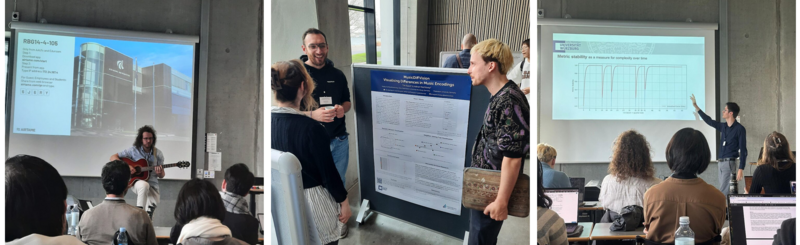
Dr. Mauro Orsini Windholz presented his research on “Conventional and characteristic harmonic sequences across Brazilian choro, Western classical music, and rock,” even picking up the guitar himself. Lucas Hofmann presented a new theoretical framework and quantitative analyses on metric complexity in Hugo Distler's motets. A new formula makes it possible to compare two pieces of music in terms of their metric complexity. Adrian Nachtwey and Tim Eipert presented a poster showcasing the tool “MusicDiffVision,” which enables dynamic visualizations of differences in digital music encodings. In addition, Benjamin Henzel from Prof. Christof Weiß's group (Computational Musicology) presented a poster on “Audio-Based Strategy for Investigating Style Evolution in Western Choral Music”.
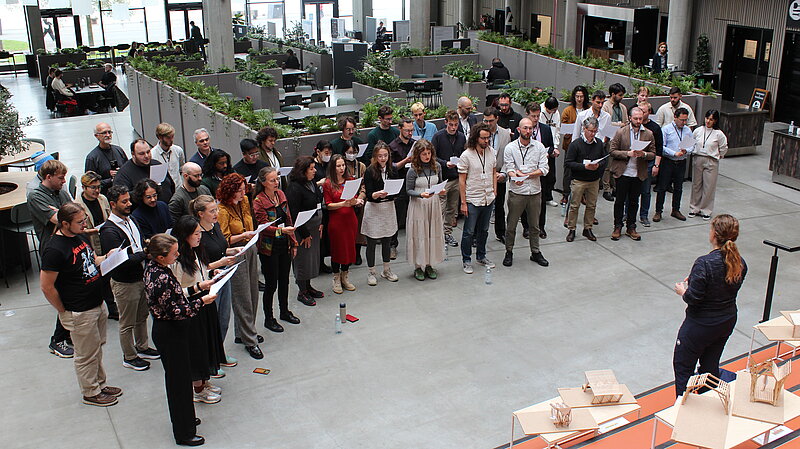
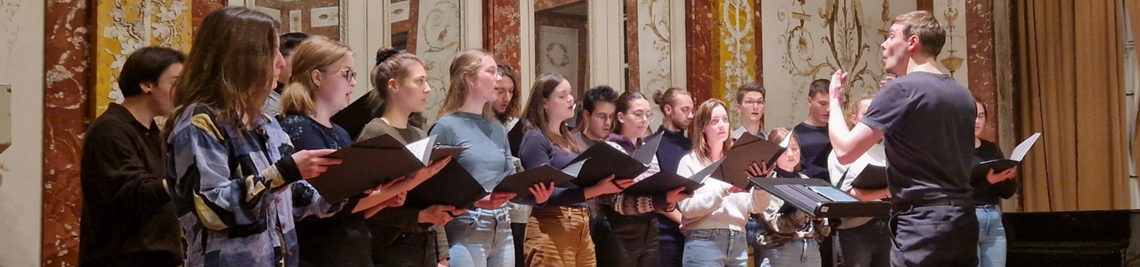
The conference presentations were preceded by a hackathon covering topics that ranged from piano sonatas by Beethoven and Barber to Ukrainian folk songs. In his keynote speech, Prof. Peter Vuust (Director of the Centre for Music in the Brain, Aarhus University) presented the results of his decades of research on the influence of rhythm on the body. One important insight was: if you want people to move, you need syncopation! And finally, there was a “singathon” in which the entire conference rehearsed the four-part German (!) Advent song “Es kommt ein Schiff, geladen”.
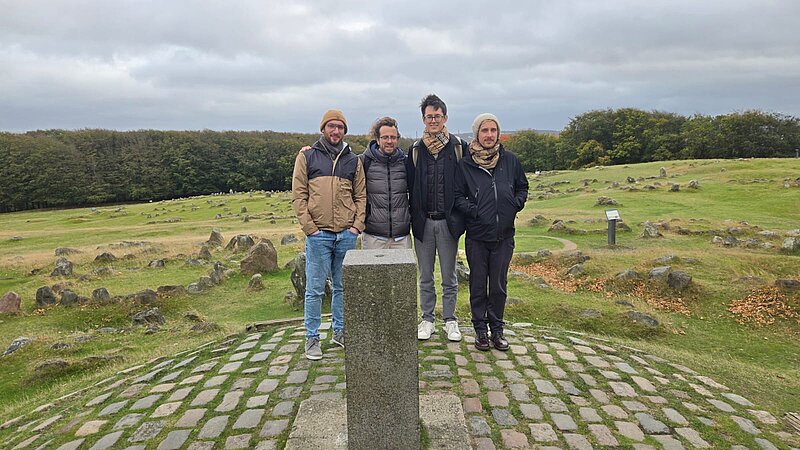
In addition to the conference program, we, as a group, had the opportunity to experience Aalborg in all its facets. A self-organized city tour took us to landmarks including Budolfi Kirke, the 16th-century fortress, the Utzon Center (designed by Danish architect Jørn Utzon, who became famous for building the Sydney Opera House), and the spectacular new concert venue Musikkens Hus, where we even attended a symphony concert. At the Center for Danish Jazz History, we browsed through shelves of records and viewed outstanding contemporary art at the Kunsten Museum of Modern Art. A real highlight was Vestre Fjordpark, a public outdoor swimming pool fed by 11°C cold fjord water, where we took a quick dip to refresh ourselves. And at the end of our stay, we were able to gather a larger group to visit an original Viking cemetery at Lindholm Høje. The museum there also had a very impressive display of local finds and exhibits from the life of the Vikings, as well as from the much older Stone and Iron Ages.
With its third iteration, ICCCM again demonstrated that computational musicology is a highly topical and versatile research discipline dealing with topics of computational music theory and analysis, music visualization, music cognition, and music therapy at a high level and in line with the latest developments.
Lucas Hofmann and Fabian C. Moss